“In any discussion about success, the words “discipline” and “habit” ultimately intersect. Though separate in meaning, they powerfully connect to form the foundation for achievement — regularly working at something until it regularly works for you. When you discipline yourself, you’re essentially training yourself to act in a specific way. Stay with this long enough and it becomes routine — in other words, a HABIT.”
— Gary Keller, The One Thing
This is a preview lesson from The One Thing Course.
When you see people who seem like they’re super DISCIPLINED, what you’re really observing is people who’ve conditioned a handful of HABITS into their lives. So, how do you go from discipline to habit? It can be hard at first, but after a certain point, it becomes easy.
Let me explain…
A habit is an automatic behavior that you do with little or no conscious thought.
- You don’t need to think about each of the steps involved in brushing your teeth—you just do it.
- You don’t need to think about the steps you need to take to back your car out of the garage—you just do it.
- You don’t need to think about how to tie your shoelaces—you just do it.
You don’t need to give these actions much thought at all, because they’re habits.
Habits put our actions on autopilot, which means that any behavior that’s become a habit in your life can be done (or at least initiated) with little to no energy, thought, or willpower.
And this comes in handy when we’re working to make major transformations in our lives.
Think about a rocket ship launching into space.
When it first takes off, it requires TONS of upfront energy and fuel in order to get off the ground.
But as soon as the rocket breaks past the Earth’s atmosphere and the rocket booster detaches, all of the weight that was holding it back practically disappears…
THAT’S how habits work.
You put in lots of hard work and discipline upfront, so you can put your habit on autopilot later.
How to build habits
So, how do you build habits?
You start with a habit loop, which is a 3-part framework for creating habits of any kind. It includes a cue, routine, and reward.
- Cue—something in your environment that triggers a habit.
- Routine—the set of actions you take in response to the cue. (the behavior you want to make into a habit)
- Reward—the results or feelings you experience from executing your routine.
Here’s an example of how you might use this three-part habit loop to create a plan for developing a habit. In this example, we’ll look at how to create an exercise habit, but you can use it as a guide for creating any habit you want:
EXAMPLE HABIT LOOP
- 🎯 Step 1. Identify the target habit.
- Ex: Develop a gym habit, whereby I’ll workout 5X a week.
- 🕓 Step 2. Pick the CUE.
- Ex: I’ll set my alarm to wake me up at 6 am every morning.
- 🏆 Step 3. Select a REWARD.
- Ex: Enjoy a delicious protein shake after my workout, revel in my sense of accomplishment, and embrace the endorphin rush.
- ⛓ Step 4. Execute the ROUTINE.
- Ex: Drive to the gym + exercise.
- ✍️ Step 5. Write it down, make it happen.
- The simplest + most effective way to form a new habit is to write a plan that includes your cue, routine, and reward.
- Ex: When my alarm clock goes off at 6 am, cue I will jump out of bed and drive straight to the gym to exercise for 60 minutes routine because it provides me with a healthy lifestyle, a fit physique, and an energetic start to my day reward.
Actionable insights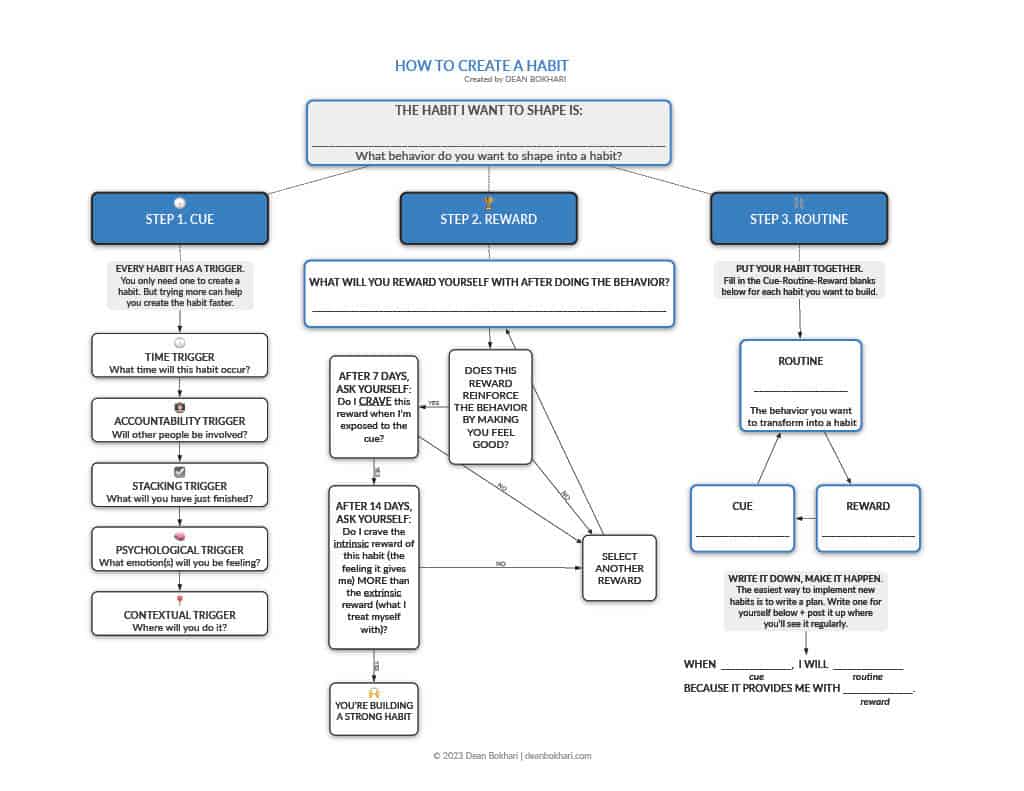
1: Think of a habit you want to create. Identify the Routine you want to transform into a habit and write it down.
- Example: My target habit is to wake up and exercise before work every morning.
2. Think of a Cue. Every habit has a trigger that launches your desired behavior. Identify the one that regularly works for you and write it down.
- Examples: Set my alarm for 6am every morning, leave my gym bag by the bed.
3. Think of a Reward. What will you reward yourself with for following through on your routine? The reward can be anything, but the key is in the craving. Experiment with different rewards until you find one that you can really crave—no matter how small or trivial it may seem. This could be something as simple as looking forward to your favorite smoothie after every workout.
- Examples: Delicious protein shake, sense of accomplishment, endorphin rush.
4. Put it together as a plan using the following formula:
- WHEN _____,cue I WILL _____routine BECAUSE IT PROVIDES ME WITH _____reward
- Example: When my alarm clock goes off at 6 am, cue I will jump out of bed and drive straight to the gym to exercise for 60 minutes routine because it provides me with a healthy lifestyle, a fit physique, and an energetic start to my day reward.
Final takeaways: how to build habits
- To successfully create new habits, remember that you’ll need to use your willpower + discipline in the beginning. This is hard. But keep at it. When you discipline yourself, you’re conditioning yourself to act in a specific way. Stay with this long enough and it will become a habit. And once you turn a discipline into a habit, you become better at it AND it becomes easier to execute. It’s all about regularly working at something until it regularly works for you.
- How long does it take to build new habits? According to research, it takes, on average, 66 days to develop a discipline into a habit. But this is an average – some habits take as little as a few days to form, while others don’t take hold for months. So it depends on your situation and the habit you want to build. Just remember that it’s not something you can do overnight.
- Discipline gets you started, but habits keep you going.
- Use goals to set your destination
- Use discipline to start taking action
- Use habits to put your actions on autopilot
If you enjoyed this preview lesson, check out the full training program here.